Me

Me

Sunday, August 29, 2021

Why do I run?

By no means have I had a shitty life. Despite all the little fights I’d have with my brothers during my teenage years, my family was pretty close . My parents loved us and I learned plenty of things I’m still grateful for: good work ethics, right and wrong, caring about others, cooking, cleaning, how to be a person. Sure there were hardships. I’m the oldest of six boys who ate a ton of food. Having three of my own ravenous little monsters now, I don’t know how my parents afforded to feed us on such little money. I know I complained about stupid things like how my friends had cool shoes and mine were always from Payless. I remember thinking and probably mentioning that I had wished they hadn’t had so many kids. Then we could’ve afforded more things. Thinking about it now, I’m embarrassed that I was so selfish.


As far as my personal life, I never used any drugs or drank or smoke at all. I lived a very vanilla life. I didn’t have any bad influences in that manner. We had family dinners at least once a week on Sundays. Although my mom would frequently tell me that my dad was never happy with how much money we spent on groceries, we never went hungry or anything remotely close to it. My parents allowed us to play team sports. I still don’t know how they managed six kids on five teams with all the games and practices all over. My dad even coached several of the soccer teams and baseball teams some of us were on. Saturdays were spent at the field all day. I look back at it and am glad that I played those sports but don’t feel nearly as compelled to do that for my own kids. 


My mom made me (almost literally) get a job when I turned sixteen. I didn’t want one. I wanted to hang out with my friends and stay up all night watching movies or playing video games like our Street Fighter II tournaments. My mom knew a lady that worked at the Walgreens around the corner from our house and put in several good words about me. I finally got around to handing in an application (because the Internet didn’t exist yet) and waited for a phone call. I scheduled the interview during my algebra 2 final at the end of my sophomore year. I didn’t have to take the final as my teacher knew how well I understood the class’s topics. So I walked across the street in my t-shirt and shorts and had my interview. I worked weekends and weekday nights. I don’t remember how many hours a week I worked and don’t remember if California had a rule on that at the time. I do know that I was supposed to be off the clock at 10 pm but frequently stayed later to help. All summer my friends would go to the beach or something else that I wanted to do. I felt a little upset that they were out having fun while I had to work. It didn’t help that it always seemed like the fun stuff happened while I was working (though I know that wasn’t the case; it just seemed that way).


When it came time to go to college, I chose what I felt was the cheapest one I could find. I didn’t want it to be such a hardship on my parents to pay for it. My dad paid for my first year, but then I got a job at a grocery store at the end of that year. I worked nights so it wouldn’t interfere with my scheduling of classes (just never slept, which was a lot easier when I was twenty). It also provided me with an extra dollar an hour and hardly any customers (they just got in the way of work). I worked 40+ hours a week for four years of nights as I finished college with 15+ credit hours each semester. Somehow I also managed to find a girlfriend (not that I was looking) and married her. Due to how much we worked during the week (and my hours at school), our “dates” were spent sleeping together all weekend so we could keep the candle burning during the week. With both our incomes, we easily paid for my final four years of school. I say easily because $3,500 a year wasn’t too difficult.


After a “teacher’s dozen” (as I like to call it), I had had more than enough of this nation’s education system. I frequently came home frustrated and had to run for an hour just to get my mind off the dregs of the day. Sometimes I came home in tears and shared with my wife the next new item that was being required of us (teachers). A dear friend suggested to me, several years earlier, that we should both quit teaching and become firefighters. The reason being that we were physically fit and wouldn’t have to deal with the broken education system any longer. I very much liked the idea. However, that would require me to take classes and change my way of life. And change is hard. I hit a few little snags along the way that made me feel like I was gonna be stuck teaching forever and would just have to come to grips with that. But then I had one horrible year. I made it through the year by writing poems describing the shit we teachers had to deal with and how I felt about it. I would then print them out and hand them out to several teachers on my off-period. I felt that we were all kinda united in our despair and that those poems sort of helped us continue on for another week and feel like each individual wasn’t really alone in how they felt. By the end of the year, I was dropping off poems and little candies to a lot of teachers and I felt like they couldn’t wait for me to stop by and chat for a minute.


The career change started during my last year of teaching. I had one class that required me to be gone two nights a week for five hours each night. That lasted for four months. There were also some weekend classes and other outside of class events that necessitated me being gone. Later that year I was gone for two weeks straight. It was quite the financial challenge (I could only use a couple days off before I wouldn’t be paid for the remainder of the two weeks) and a mental challenge to be away from my family. But upon completing all that, a department had a hiring test a few weeks later. And a couple weeks after that, I started that new job.


As I look at my life, I don’t feel like it’s been so hard. This is especially true when I hear stories of friends and their upbringing. Life is meant to have hardships in it. They make us stronger (as long as we push through them and figure things out and don’t give up). I still don’t have many things in my life that I’d consider terribly difficult. I love my job and love going to work. In four years I haven’t used a single sick day and don’t know that I ever will have to have a mental health day like I so often needed with teaching. And because my life seems to go so seemingly smoothly, I have to create artificial hardships to make me a better and stronger person.


Running 100 miles isn’t easy. I know I’ve done it very successfully over the last ten years and most people tell me (jealously?) that I make it look so easy. But it’s not easy. Even the ones that I’ve completed a handful of times. There are always moments when I question why I do this to myself. Some of the moments last a few miles. Some last a few hours. Why can’t the race just be 30 miles? Or 50? Or 83? Why did I sign up (again) for the longest race. If I did one of the shorter ones, I’d be done right now and comfortably sitting around. Most people would still be really impressed with being able to run that much. However, those distances are never the original goal. And although my goals frequently change from the ‘A’ goal to ‘just finishing,’ I rarely allow myself to not at least accomplish that final goal. Being able to endure to the end is such a mental drain. I know my body is physically capable of it. It’s also my opinion that most people are physically capable of traversing 100 miles, even in their current state of physical (un?)fitness. The overall time doesn’t matter. Enduring matters. Not quitting matters. Pushing yourself to the limits matters and winning the fight against your brain as it continually wants to quit and make your life easier. All these long races I’ve done have strengthened me.


The mental toughness is what I really care about. It refines my brain and my control over it in a way that I haven’t had many opportunities in my life to do. Over the last ten years as I’ve completed many ultra marathons, it is my opinion that they have allowed me to become a better person. Not that I needed saving from any horrible life. But I am certain that I’m a better person now than I was ten years ago. And if you want to know what I’m talking about, sign up for a 100-mile race and promise yourself that no matter what, you won’t quit. Find friends and family to help you. They’ll walk with you. Infect them with your making-yourself-better spirit. It’s worth it. Future you will thank you many times over.


Friday, February 22, 2019

I broke my own rule! Rookie mistake. I was having the time of my life. I was running 10-minute miles. Nothing was hurting. I had settled into a routine that I felt could last all weekend. Nutrition was great. I wasn't tired or sleepy. At midnight, 15 hours into the 72 hour race, I had 79 miles completed. Then my right Achilles tendon started to feel weird. I had to slow down. Then I had to walk. Then I had to get off my feet to hope the pain would go down and I could go back out. After each break, I did 7 laps, then 4, then 3, then half a lap before it started to hurt too much. Is this what it's like to be human? Rule #1- Don't get hurt during a race. My goal of 250 miles was not going to be happening. I was at 90 miles when the sun came up. It took 9 hours to get those 21 miles from midnight so I could at least have 100 miles. As I came in one lap, I told Rob about my Achilles. He said that's what happens expletive expletive expletive when you just ran 200 mountain miles 10 days ago. Then he said a word that I didn't understand; I had never heard it before.


Rob- "That's what happens with overuse." Me- "I don't get it. What's that?" I decided that some things were more important than getting to 250 miles, winning a couple competitions against some friends, or getting a huge belt buckle. I am done, 48 hours before I'm supposed to be done.

Amy told me we were NOT going to El Paso next year to do Franklins 200 mile or 200k or Lone Star 100 mile or 100k. Today I told her that she made her opinion clear on the subject and that I agreed, finally. If I cut out that race, I can be fresh for next year's 72 hour race and do what I was supposed to do this weekend.

Here's what my left (normal) and right (a little swollen) Achilles look like. Hopefully it's good enough to run to work on Wednesday.


Wednesday, September 5, 2018

If You Don’t Like the Heat, Just Finish Sooner

It’s Not My Fault If You Choose To Follow My Husband’s Advice Issue #8 If You Don’t Like the Heat, Just Finish Sooner
I had a race this past weekend and after I finished, I had an apostrophe. Lightning struck my brain. I told Amy to text me so I wouldn’t forget it.

The race started at 6am in San Antonio. It was a cool mid-to-high 70s morning (cool for us at least). I had never been to this park so I took the first lap easy (6 laps of 5.4 miles each). Then, after I saw how much fun the course was in its entirety, I ran a bit harder the 2nd through 4th laps. The sun started getting higher and hotter during my 5th lap (10am) and a lot more during my 6th and final lap (11am). It was during my last lap that I realized how glad I was to not have to run any more laps. Not just because being finished is a great feeling, but because it was getting a lot warmer. I sort of felt bad that so many others running the 50k (31 miles) had to be out there all afternoon to complete the race while I had it easy finishing before noon.

I will also mention that this logic applies to the dreaded/awesome Habanero 100. It starts at noon and you must be finished by 6pm the next day (30 hours). You’re gonna have a lot of sun time no matter what the first day. But if you don’t want to be in the sun ALL day the next day, just finish as the sun is coming up and then you can skip the heat.

So, in conclusion, if you don’t like the heat, either you must run faster or move to some northern state that thinks 80 degrees is hot. Or just suffer through the heat and hate those jerks that finish early. Just understand that they know that the ones who endure the long hours of exposure are the real crazy tougher than nails runners.

Thursday, August 2, 2018

Make Races a Family Event

It’s Not My Fault If You Choose To Follow My Husband’s Advice
Issue #7

Make Races a Family Event

When I was in high school running track and cross country, those sports were listed as team sports, and I loved my team, but it always felt like an individual sport and I helped contribute to a team. Now, when I have a race, it’s usually most of the day or all day or a few days of nothing but running (and walking and sometimes sleeping). And since I have a family, I don’t feel right about telling my wife to take care of the kids while I go off and party all weekend with a race. So, they come along.

From my first 100-miler when we only had two kids (4 and 2) and it was 30 degrees outside, my family has always come to my races. They cheer me on throughout the day and give me so much to look forward to when I start getting close to an aid station. I love their high fives and “Go dad” and trying to keep them out of the way of other incoming runners.

Now that my kids are getting older, my wife and kids will also sometimes run the shorter races. I love being able to see them on the course and give them high fives as we pass. It’s so fun hearing others tell me that they saw my kid out running and what an inspiration that was and how they need to get their kids (or grandkids) out on the trails.

One of my favorite parts of being on Team TROT is that I’m one of the few that has a family. I like showing that running isn’t just for singles. It’s totally a team sport. The team may consist of your actual team members, other runners you meet, or all the volunteers at aid stations. But my favorite part of running is my family team.

Wednesday, July 4, 2018

How Do You Get to Work?

A year ago I was kinda forced into a horrible situation. My wife was at work and wouldn't be able to take me to work in the morning. Here's the story and why I'm a better person because of it.

Back in my other life when I was a teacher, I biked to work. It was 10 miles round-trip and 6 miles round-trip for the two schools I worked for. It allowed us to have just one car. My students would ask why I didn't drive. Was it to save the planet? Get exercise? Save money on gas? My answer was always yes. But the real reason is because I'm cheap and I don't like being like everyone else. What family only has one car? It makes me different.

When I switched careers, Amy woke up early to take me to work and would then go back to bed. We did this for about six months. I really was wanting to up my mileage but sometimes (meaning always) I'd feel too lazy and would only end up doing much less than I felt like I should be doing. Last year I worked on July 4th. We were going to have our families up at the station and that involved Amy not working that night. She worked the night before instead. The dilemma arose as to how I was going to get to work. I could bike, but I always worried about getting flat tires. And then it hit me and the problem was solved.

I mapped out my course that I would follow to run to work. Almost 10 miles. Then to figure out my pace so I would know how early I'd need to leave. Then to add on my shaving and getting ready for the day. We got a plastic tote that I could leave my clothes and all inside so that I could shower when I got to work.

I have run 86 times to work (best schedule ever!) over the last year. Rain, windy, hurricane, thunderstorm, hot, cold, whatever. I wake up at 3:30 a.m. and leave my house at 4:00 to run 10 miles to work. I love it. It has made me more determined when the sucky moments arise in my races and the voices tell me to quit.

Thanks to my sponsors that provide my necessary gear. Nathan for the Peak waist pak that holds not only water (since it's nice and hot even at 4 am here) but also my phone and mp3 player. Also for my favorite handlight, the Zephyr Fire 300.   AfterShokz for the headphones that 1) don't block any outside noises so I can still hear cars and other stuff around me but also 2) have already survived many sweaty hours and still work great. Altra for my new favorite shoes. I've put tons of miles on them and they still feel wonderful. DryMax socks for some pretty cool foot protection. I haven't had blisters yet. Victory Sportdesign for bags to organize my extra clothes that I leave at work. And Trail Toes for anti chaffing cream to keep my thighs happy after running in the heat and humidity.


Friday, June 29, 2018

Tapering is a Sin

It’s Not My Fault If You Choose To Follow My Husband’s Advice
Issue #6

Tapering is a Sin

I always read people’s week-before-a-race comments about how they need to cut down the miles and make sure their body is all ready for the race. And I guess if you’re an elite pro, that might be kinda important. But for the rest of us, why are you killing yourself on all those other weeks? Enjoy your “training” (happy Marc?). Run nice and easy all the time and you have no need for prepping for a race because you’re already ready.

Here’s what I do the week before a race:

  • Run every day- however much and for however long I feel is good
  • Don’t eat anything new/weird that I don’t know how my body is going to respond to it
  • Try to sleep a lot all week (especially if I know I’m gonna be up all night racing)
  • Cut my toenails about a week before the race (so they’re not sore from cutting them too short)
  • Make a list of the things I will/might need during the race and after the race (it sucks when you start freezing post-race due to calorie deficiencies and you only brought tank tops and shorts cause it’s hot outside)
  • Charge all my head/hand lights (or bring spare batteries)
  • Double check that I am bringing my water pack
  • Make sure I have directions to the park
  • Sleep in a tent at the park the night before the race so I don’t have far to go in the morning and can sleep all night
  • Don’t get hurt (see Issue #4)
  • Make sure your family comes to the race


Friday, June 15, 2018

Training Plans Are Dumb

It’s Not My Fault If You Choose To Follow My Husband’s Advice
Issue #5

Training Plans Are Dumb


A long time ago I was running a 100-miler, Rocky Raccoon, for my third time. Some university was doing a study and we could volunteer to be a part of it. They sent us some questions pre-race and videoed us running by the spot where they set up camp for two days. This spot was of course where you needed to run because you didn’t want to be the one they all secretly laughed at when they rewatched the films- “Hey look at this guy walking...again!” But the point of this is one of the pre-race questions they asked: “What do you do for training?” And that got me thinking. What do I do for training?

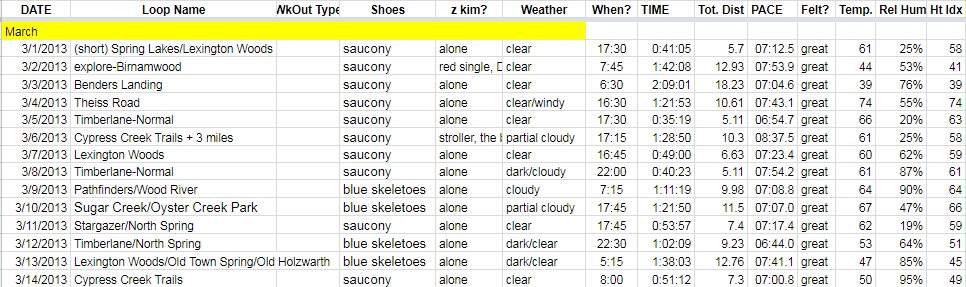
To me, training involves having a schedule of things you need to do beyond just going out and running. Monday- run 20 400s with 30 second walk breaks on the track. Tuesday is long run day- 8 miles at x:xx pace. Wednesday is a 5-mile tempo run- keep pace between x:xx and x:xx. Thursday is weights blah blah blah blah etc. etc. etc. Ever since I was helped into discovering how amazing running long distances is and found out how I could get my body to fairly efficiently do this, I never had a training plan. I just went out and ran. I simply liked running. It didn’t matter how long (as long as it was at least a mile) and it didn’t matter how fast (even if it was walking). I just had to go outside. If I felt good, I might pick up the pace a bit. Or not. If it was hot, let’s slow down so I don’t melt. Sure, I log all my miles, my pace, anyone I ran with, the weather, temperature, which shoes I wore, how I felt, the humidity, the loop- all that’s shown in the table below. (FYI-I almost always feel great. It’s easier to run when you don’t feel bad.) But all that information is for some future study that will need to know how I became the runner that I am. It’s my proof that what I do and say works. I don’t do much with the numbers.


So when I answered the researchers’ question about what I do for training, I replied with “I don’t consider anything I do as training. I just go out and run. If I feel good, I go faster or longer or just keep the same pace. If I feel bad, slow down. When I step out of the house, I think, today I’m gonna run 10 miles cause I feel this. Or I’m gonna just do this small 3 mile loop cause I feel that. Other than getting out of the house and running, I don’t have any other preconceived plan about what I’ll do.” That’s not exactly what I told them, but that’s the spirit of it.

A few other tidbits about my “training.” I run almost exclusively on the road or paved trails. The only time I get on non-paved surfaces is when I race. I live near Houston, and there are quite literally no hills. I might gain/lose 100 feet over 10 miles, and that’s if there’s an overpass I need to go up and over. The only hills/mountains I run on are when I race. My daily running is always done in road shoes. And unless it’s going to be raining, I wear my road shoes for race day too. I carry a watch that I got when I was in junior high so I can track total time while running. But I never look at it while I run until I’m back home and stop the timer. I don’t have a heart rate monitor. I don’t buy new shoes until they have a couple thousand miles on them. I never stretch or use a foam roller (wouldn’t even know how to use it correctly). I don’t do weightlifting (although I occasionally do this now--not for running but for my job as a firefighter). I don’t listen to music (although I do listen to books). When race weekend is coming up, I don’t do anything different in my “training” like tapering (which is also dumb). And in spite of all these things, I’ve never been injured and have had a rather successful (in my opinion) running career that is still in its infancy.

Thursday, June 7, 2018

Don’t Get Hurt

It’s Not My Fault If You Choose To Follow My Husband’s Advice
Issue #4

Don’t Get Hurt

This seems to go without saying. But some people just go and do it anyway. And there are several aspects that go into making sure you don’t get hurt.*

  1. Don’t go fast  When a course has some slightly to horrendously technical sections, going fast is the best way to go if you want to hurt yourself. You’ll move a loose rock you just stepped on more than at a slower pace; you’ll have too much momentum going when you hit that little divot that rolls your ankle; you'll be kissing rocks with your knees or your face when you trip and fly ten feet. Just don't go fast. Run slow. 
  2. Choose the longest distance  If your race has multiple distances to choose from, choose the longest. That way you won’t be able to go fast. And if you do, you won’t for long. And if you don’t go fast, you won’t get hurt. I’m not saying you won’t trip and fall, but it won’t be as bad as that fast guy falling.
  3. Drink lots of water  I once made the mistake of not taking water with me for the last 40 miles of a 100-mile race because the temperature was dropping that night. I would drink at the aid stations, but didn’t have my pack with me for continuous hydration. I finished with an amazing time and place. However, when I was done chatting with friends post-race, I was ready to go to bed and got up only to pass out. Then again. Then my wife took me to the emergency room to get some fluids put back in me. I wasn’t seriously hurt, but I wouldn’t ever recommend going long without having a good water supply with you. It’s not worth the risk.
  4. Wear short shorts  Some people haven’t heard the secret of wearing shorty shorts. I won’t be the one to spill the beans, but you should definitely try it. It’s worth it.
  5. Don’t follow a training plan  They’re dumb. That’s all I have to say about them for now.


*This is not an all-inclusive list. It also may be an over-inclusive list or insanely under-inclusive.

Friday, May 11, 2018

If Your Shoes Don't Have At Least 2,000 Miles On Them, You Don't Need New Ones

It’s Not My Fault If You Choose To Follow My Husband’s Advice
Issue #3


If Your Shoes Don't Have At Least 2,000 Miles On Them, You Don't Need New Ones


I should've bronzed these and put them on my buckle shelf


I’m cheap. I mean, really cheap. I don’t like buying stuff I don’t need (the kids make this a little bit of a grey area as we buy them lots of stuff they don’t need). I don’t like going out to eat at a restaurant. I don’t like buying new clothes. I don’t need a second car. I don’t have a flat screen TV. You get the idea. And I’ve been like this my whole life. Before I was part of Team TROT, I was a runner clothed in whatever was cheapest at Academy (sports store) or Ross. If it was over $40, I didn’t need it.

Running is the earliest sport and most inexpensive. It was one of the first things humans did (even if it wasn’t sport) and it required very little, if any, equipment. Just get out and go somewhere. This is one thing that appeals to me about running. And even now that I have sponsors for some of my equipment, it’s hard for me to let go of who I am.

The way I used to pick out running shoes was to go to Academy, find the section that had running shoes that were between $30-$50, and try them on. One shoe on one foot and a different one on the other. I’d run up and down the aisle, and the winner would go on to the next round. This would continue until I had found my shoe for the next year. I know that early humans couldn’t buy shoes, but at 11 cents per day, I could afford these shoes.
It didn’t matter if they were trail or road shoes. In fact, I didn’t know there were such differences when I started running ultras. I was at Cactus Rose 100 going up a hill, and a guy behind me asked if my shoes were road shoes. I didn’t know what to say. “I guess so.” They were road shoes (as I now know), but they worked fine and got me through that and several other trail races.

Anyway, back to the point of this. I never wanted my running habit (as I was running more and more and racing more too) to become expensive. I knew that running shoes were expensive. Companies tell you to replace your running shoes every 300-500 miles. But I couldn’t afford to buy a new pair of running shoes every month and a half. So I wouldn’t. And I found out that nothing happened. So I kept running in them. And running. And running, until they literally fell apart. I remember the first time that happened and I recalled a pair of running shoes that I used in high school. I had them from sophomore year until i graduated. All the rubber on the bottom was worn off, duct tape surrounded both toe boxes, and they were comfortable as hell.
For the last 3-4 years, Altra has been a sponsor for the team. And although it took me a little while to get onboard with running with these shoes, I really love them. They have a wide toe box, zero drop soles (heel and toe at same level), and a great selection of trail and road shoes with minimal to maximum cushioning levels.
Now, I don’t know if I have some perfect stride or the perfect foot strike or whatever and that this is the reason for me not getting hurt while putting a ton of miles on each pair of shoe that I own. But I can tell you that I’m never injured. I’ve been tracking my shoe miles since 2010 and the table shows when I purchased and retired the shoes with how many miles each have. Form your own opinions. Share them if you so choose. Experiment on your own. Just don’t get hurt.

#ZeroDrop
@altrarunning


Friday, May 4, 2018

Talk to Other Runners

It’s Not My Fault If You Choose To Follow My Husband’s Advice
Issue #2


Talk to Other Runners


I’m not a very outgoing person, especially if I don’t know you. I don’t typically like meeting new people and stepping out of my comfort zone. This very much includes talking to complete strangers. However, running ultras has sorta changed that part of me. I still don’t talk to lots of people, but I race-chat a lot more now than I ever did when I started this back in 2011. And I really enjoy it. The talking may be just for five minutes while our paces match or it may end up being 85 miles (a 15+ hour date!). There are so many different reasons for race-chatting. I’ll try to get all the angles on why you should talk to other runners while you run. They are in no particular order, except when I quiz you on them at the next race.


  • Pass the time
    Talking to others will keep your mind off the pain, suffering, boredom, low points, etc. that you might be enduring. Before you know it, you’ve gone 10 miles and it happened so effortlessly.
  • They feel better
I can’t confirm this one. And I know what assuming does, but I’m assuming that they feel good too since I do.
  • You know you’re running the right pace
When you can carry a conversation without constantly losing your breath, you’re going at a pace that can be continued for a long time. One of my hugest advices is to run at conversation pace.
  • You get to know someone new/make friends
Now that we’re adults, we kinda suck at making new friends. You may never hear from this person again. You may end up being bff’s. They may be a name you’ve heard of but now can put a face to (unless you’re a Facebook stalker). Maybe you already sorta know them, but now you can find out something more. And maybe you like them enough that you want to spend the rest of your life running with them and Rob Goyen marries the two of you after you finish your first 50-miler as a couple.
  • Gives you a break/picks up your pace
Sometimes we’re silly and don’t correctly pace ourselves even though we know better. This can be your opportunity to slow down and give your muscles a chance to recharge. Or it might be that someone faster came by and you picked up your pace to run with them for 10 minutes and that got you out of your walking rut.
  • You’re not gonna win anyway, so have some fun
With the exception of a few people in each race, none of us really expect to win. We’re out there to challenge ourselves. Going a little slower at one point isn’t going to ruin your race or be a pace killer. It might be just what you needed when you’re at a low point at your race and you reflect back on this fun memory that your new friend shared earlier that day.
  • You get to see that your race/distance is not the only one out there
Races with varying distances usually have staggered start times so not everyone is crammed onto the narrow trails in one spot at one time. Maybe you never knew of 50-mile or 100-mile races. Talking to one of these “crazies” might spark your curiosity and cause you to discover what your real limits are and become one of these normal people.
  • You feel better (aka-the selfish reason)
According to a show I used to watch, there is no such thing as a selfless act. The real reason why you are nice and talk to others while running (whether you think of this or not, but now you will) is because it makes you feel better. And races are so much easier to endure if you just feel good all the time.


I am certain that the coolest and most interesting people are found on the trails. You just have to talk to them to discover it for yourself (and help them to discover you).


Wednesday, April 25, 2018

Running and Ice Cream Will Solve All of Your Problems

It’s Not My Fault If You Choose To Follow My Husband’s Advice
Issue #1

Running and Ice Cream Will Solve All of Your Problems

After some races I get to talking with people and my goofy advice always comes out. And just recently, I decided that I would like to share why my advice isn’t as goofy as one might think.

But I feel like I should preface this and every article that I write with one my wife’s favorite sayings at races: “It’s not my fault if you choose to follow my husband’s advice.”

Feeling sick? Headache? Lonely? Depressed? Anxious? Tired? Hungry? Stressed out? Getting over a bad break up? Don’t want to get out of bed? Overworked and underappreciated? No coffee? Frustrated? Kids driving you crazy?

Whatever it is, running can solve it. You might not be at a time in your life when physical activity is as easy as it was when you were 15, but that’s ok. You gotta start somewhere. Go outside. Walk. Jog. Run. Whatever you want to call it is fine. Just go out and do it. You might only be able to go for 10 minutes before you call it quits. Maybe you can’t run 3 miles without walking. So what! Don’t make excuses. Just get outside and do what you can. Don’t hurt yourself by pushing yourself to limits that shouldn’t be explored for several months or years down the road. But go outside and do what you can. It doesn’t matter if it’s in some beautiful forest or your favorite hiking trail or on the sidewalk around your neighborhood block. Getting outside and running (or whatever) will help with the problem. I won’t tell you how. You get to figure that part out only if you make the commitment to yourself to consistently get outside and run. Don’t take any headphones or music. They won’t help you solve your problem. Go out and just run. Do it several times a week. Make it a priority. Find your answers. And since you’re out running, you might as well reward yourself with some ice cream. Don’t make it boring vanilla either, unless you’re having a rootbeer float. Try rocky road unless you’re allergic to nuts. Then just give it to me.

Sunday, January 7, 2018

Here Comes The Sun (do do do do)


There are two things that bug the bejesus out of me while trail running. The first is seeing trash on the trail (or anywhere for that matter). Ask my kids what their new punishment is. The other is as follows:

While finishing the last 20 miles of my race, I had to bring out my light so I could see since the sun decided to go down before I could finish. My current location on the course contained two-way traffic. Over and over, as a fellow runner came toward me, this was my view (unless they had a pacer, then double the lights). Now, as fun as looking into the sun and then attempting to keep running while blind for a few seconds may sound, I really hate it. This caused me to reflect back to my early days of running ultras and the lights I used. My first headlamp was about $10, used one AA battery, had two itty bitty LED lights, and (now that I look at the output) I swear was only good for reading a book while not moving at all. I don't know how I could see the trail as I ran through rooty forests or up and down crazy rocky hills with that tiny little candle on my forehead. Fast-forward a couple years and I bought a brighter one which worked much better until it got too temperamental to be trusted anymore.

Zephyr Fire 300 (link to product)
What I currently use isn't a headlamp. It's a hand torch (flashlight) from Nathan (click for link to product). I have never liked having anything in my hands while I run. My hands are happiest when they're empty. So I was a little hesitant to get the hand torch. However, as you can see, it has a little wristlet doohickey that allows you to hold it without needing to really grasp it. (It's also great for when you trip over roots so you don't lose your light.) The light is already angled downwards. This allows you to see all that you need and allows oncoming traffic to not be blinded. I've used it through most of the night before, even though the webpage claims only 6 hours on low.

Now, I'm not saying you need this particular light. But please remember that when your mini sun on your forehead is fooling the squirrels into thinking it's morning, every oncoming runner you encounter is getting blinded because your light isn't angled properly. Please be courteous to your fellow trail nerds.

Tuesday, May 9, 2017

Wildflower Race Recap OR How to not end up walking at the end of an ultramarathon

So I ran Wildflower this last weekend and I told myself it’s just a 50k and it’ll be over before I know it. But the other part of my brain told me that since it’s shorter, I’ll have to run faster. And I hate running fast. And before you think that, the terms ‘fast’ and ‘slow’ are all relative. Your fast is someone else’s slow and vice versa. And your slow at the beginning of a race may be lightning fast at the end of your race.


How to run right (according to me)
Let me preface this all with what a gold shiny friend once said about me: “He has been known to make mistakes...from time to time.”


I’m too cheap to get a Garmin or Suunto or whatever. I learned to run by listening to my body. It might sound like I’m some Zen man or whatever, but it’s the only way I know how to describe it. And I use this to help me with my long 50-100 milers. Maybe the same concept works with shorter runs. I don’t know. Try it out. So here’s what I’ve learned that works great for me.


If you go too fast for too long, your muscles will die out before you’re mentally ready to quit. So you have to slow down at the beginning. It’s a little annoying because you feel so fresh and you just want to go at the pace you feel comfortable with. But believe me, ‘future you’ is gonna open a can in about three hours down the trails. And it won’t be pretty. Lots of people will be ahead of you and the competitive devil inside you will try to convince you to speed up. But for most of us, we’re not out here trying to win. We’ve all got various reasons for why we torture ourselves (as others consider it). You need to keep your body’s work output lower than what it can produce from your “energy reservoirs” and the awesome aid station all-you-can-eat buffets. Otherwise you’re using up energy faster than you can produce it, ‘future you’ becomes ‘present you,’ and then Pandora’s Box is opened.


How do I know when I’m going to fast? Again, I never even look at the watch I carry. It’s strictly used to keep track of overall time when I finish my run. You could use a heart rate monitor and do whatever calculations keep you below your max heart rate. But that’s a lot of work. I feel that heart rate is closely connected with breathing rate. All I need to do is listen to my breathing rate and that doesn’t cost me a fancy anything. If I’m breathing hard and fast, my heart is beating too fast, and I’m running too fast. And ‘future me’ tells me to slow down. My favorite pace is what I call ‘conversation pace.’ I’m pretty sure I got this from the Bible*. It states that if you’re running too fast to hold a long conversation with someone, you’re running too fast (for a long endurance run).


My race recap from this last weekend’s Wildflower 50k at Bastrop SP
There were five 10k loops. My times were 55 minutes, 53, 56, 59, and 61. Consistency goes along with paying attention to your breathing. I know I could’ve ran a much faster first and probably second lap, but then my other laps would’ve been incredibly slower. I have found that consistent pace with a jog is better than a fast run followed by slow walking. I found a pace that felt slow enough that I’d be able to hold it throughout the race. I was by myself for a lot of the time- sometimes this can be difficult because there isn’t anyone to encourage you, but it can also be good as you won’t get sucked into someone else’s race pace. I vaguely remember stopping at the aid stations to refill water, pick up some pbj’s and gels, get a sponge of ice water over my head, and then be on my way. But I know that the volunteers helped get me back out on the course a lot faster than I could’ve done on my own. Huge thanks to all of them.


Gear Used
Shoes: Altra Lone Peak NEO- I’ve mentioned this before but I’ll say it again. I don’t think this was the purpose in the design for the shoe, but there were plenty of sandy spots on the course and after finishing the race and removing my shoes, I had NO SAND at all in my shoes. Just sayin’.
Water: Nathan Peak waist pak- The aid station was only 3-3.5 miles away and the insulated 18 oz bottle was plenty large enough to keep me hydrated and keep the water colder for longer.
Gear Bag: Victory Sportdesign Kodiak- I love the moveable dividers on the inside. I also like to put another one of my Victory bags (the Bear III) inside of the Kodiak for even more organization.


*The Bible being referenced here is “Born To Run” by Christopher McDougall.


Brazos Bend 50- April 2017

I had just tied my shoes and was finishing up my breakfast which consisted of a small handful of granola from Katie Graff, when all of a sudden I heard Rob Goyen counting down "5, 4, 3, 2, 1, GO!" and I thought to myself, "Well, I should probably put my drop bag by the aid station and start this race." It's one thing I love about ultra running- there is an overall hurry but a minute or two lost here and there don't really make much of a difference.


The weather was beautiful for a long run, but I knew it wasn't gonna stay that way and was ready for the upcoming heat. I had my Nathan 4L water pack which has two 18 ounce water bottles in front and I put a 2L empty bladder in the back in case I started going through water too quickly.


I took pbj's at the first several aid stations so I could have some real food for fuel before I switched to gels. And this is about all I ate throughout the whole race- I was promised a certain ice cream truck was gonna stop by but I must have missed him.


I ran the race by myself the whole time. Usually I like to find people to talk to and run with for awhile, but I didn't do that this time. I got to spend the morning entertaining myself.


The race has an out-and-back section with a turnaround at 4 miles before the finish. This is my least favorite part as it seems to get longer and longer each next time you run it. On my first of three laps I counted runners ahead of me. I was in 13th place. I didn't know what to expect, but decided to go about this one like every other race: find a nice sustainable pace and maintain it til I finish. I think it's the best way to run ultras. It's not easy as you have to run slow when you have plenty of energy. But the tradeoff is that at the end, you'll still be jogging instead of walking. And walking sucks (at least to me). It takes a lot of patience to know that there are people ahead of you and that you could easily pick up the pace and catch them. But I've done this enough times to know that patience pays off. Eventually. It just took a couple hours til they slowed down and I passed them.


By my third and final lap, there were runners from other distances on the course and I had a hard time knowing exactly which place I was in. So I stopped worrying about it and just kept running. But the goofy me saw two opportunities to have even more fun than just running 50 miles. With about 100 meters to finish my second lap, I saw Bhakti Chavda up ahead. I got close to her and them with about three steps to the finish I jumped between her and her friend and said "I beat ya Bhakti." I still had another lap to complete and didn't dint at the aid station long enough to let her yell at me for scaring her.


The other opportunity for fun presented itself on the dreaded forever-long out-and-back section. I had seen another friend, Lisa Decker, a number of times on the course. This time I got her. I snuck up on her as best as my I've-already-ran-43-miles legs could and I jumped and grabbed her shoulders. We laughed and hugged it out. I might owe her some Fireball now.


Back to the race. I felt awesome the whole time. No down times. And that helped me run the entire time. I never stopped except to pick up my pbj's and refill water bottles. Proper pacing is the key to success.


I used an ice bandana on my neck through the last two laps. I filled up my 2L water bladder with 12 miles left. It was nice not having 4 pounds of water on my back for most of the race.


I saw Luis Murillo coming back from the turn around, just a few minutes ahead of me. I never caught up to him, but was glad that I was almost done. I came into the last aid station and gave Rachel Adamson her last sweaty hug and thanked the volunteers for being there for us. My middle son Drew was waiting for me to race me to the finish with 100 meters left. He beat me. And then I was told that I was 3rd place. I really didn't expect that and had long since lost count of my place. I finished a few minutes behind my TROT teammate Luis Murillo for the second race in a row. I didn't beat my time from my first time out here, but it wasn't a bad time. I finished in 7 hours 15 minutes (8:42 pace). I was able to enjoy the rest of the afternoon talking with friends and hanging out (another great part of trail racing).


Four things I learned about the alligators in the park: don't feed them; don't approach them; don't annoy them; don't molest them. I'd have to agree with the last one.


Shoes: Altra Torin 2.5
Water needs: Nathan 4L Krar vest
Gear bag: Victory Sportdesign Kodiak


Sunday, February 5, 2017

Why?

Since 2011, I have raced in several 100-mile races. And with the exception of one that has foiled me twice, I feel I have done fairly well while racing. For a few reasons, I did not compete in this year's Rocky Raccoon 100. It was a very hard decision to make as I have raced it very successfully over the last six years. A friend of mine decided that he was going to run his first 100-miler at Rocky. He completed the Habanero 100 (100k) for his first ultra. And since I was not going to be racing, I felt that I should ask if he wouldn't mind if I helped crew and pace him for the last forty miles. I never dreamed of how much this would affect me.

His first two laps were what I expected. The third was much slower. As I waited for him for two and a half hours, the lazy part of me wanted him to have already decided to quit because I was getting tired and wanted to go to sleep. He came by and I happened to see him. I quickly got up and ran over to him. He was very upbeat and ready to go out. My sleep would have to be put on hold for a while.

I have never paced anybody so I could only guess how I should handle this. I know how I like to be paced, but I did not know if the same would apply for him. We talked about various things, joked around, and avoided root snakes. For the most part, I stayed about 10-15 paces ahead of him. It felt weird, but my thoughts were that he would see me start to run and then he would just follow. I could be his voice in his head (I am the good angel of course) urging him on. It worked very well. We worried a little bit about making the cut-off times, but it all worked out and he finished.

But that is not what I really wanted to talk about. I was thinking about why I race 100-milers and love them so much. They remind me about life. Some parts suck or cause you pain and you just have to get through them. Sometimes you are on the top of the world and nothing can stop you. You get a reward for persevering to the end. There are countless people, most of whom you do not know and will never see again, that are part of your life for a little while and you get to share your life with them before they disappear, sometimes forever. No matter how great or seemingly insignificant you are, there are tons of people pulling for you to be successful. You are never alone. The amount of time that you are out there varies for everyone. To be successful, you need to learn from your mistakes and hopefully share that knowledge with others. Sometimes, no matter how well you prepare, your plans fall apart and you need a Plan B or C. Sometimes you fail, so you try again and again until you figure it out. I'm sure that I can add more if I ponder it during my next race.

I am so fortunate to be a part of Team TROT and the other running families that my family has met. Never in my life did I ever expect to have so many wonderful friends that I can consider family. I cannot imagine a life without running. It is truly a necessity in life.

Monday, February 1, 2016

How Can I Possibly Train for an Ultra if I Have a Family?


Spending time with my family has never detracted from my running. Or is it that even with the few thousand miles I log each year, running has never stolen my family time? However you put it, my family is part of my running and vice versa. I have been running ultras since 2011. At that time, we had two kids and the oldest was almost four years old. However, this was not when the ‘crazy’ long runs started. I had been logging long runs on the weekends for over a year by this time. At the time, this was training for birthday runs since I had no idea the ultra world even existed. With two young kids, I wanted them to be a part of my runs and to raise them seeing how fun running could be. Actually, I wanted my wife to have a few hours to herself while I was off ‘playing.’ We had previously purchased a double jogging stroller and if it knew how many miles that I was going to expose it to, it would have convinced its former owners not to sell it on Craigslist. I wore through one set of tires and ended up putting about 2600 miles on the stroller overall.

The boys were 2 ½ years and 6 months old when I started recording that I brought them with me on my runs (though I am pretty sure I started much earlier than that). At first, they would cry, sometimes for very long stretches. But I just kept pushing them trying to ignore the awful screaming. Eventually they got used to it and I would take them out with me every weekend on two to three-hour runs. If it was cold outside, we made sure to bundle them up and cover them with blankets. When it rained, we clipped a clear plastic table cloth around the stroller. When it was dark, we had little flashy lights. They had toys to play with, sippy cups, and even some snacks when they were older.
 
We had also purchased a bike trailer that my wife would use to bike with me while pulling the kids behind her. I remember a time that we took a paved park trail out ten miles and then had a little family picnic before we turned around and came back home.

Once I discovered ultras, my family was right there to support me. At that time, my wife had a hard job of crewing for a rookie and taking care of two crazy boys. But I think she understood how important running was for me and was willing to help me in any way possible.

As the boys grew, pushing the stroller became more difficult, but I just figured it was my weight training since I hated going to the gym. And then we had another kid. Right from birth (well, maybe a week later) she was stuck into the double jogging stroller with her two older brothers. They would care for her while we went out running. And if you’re wondering how three kids fit in a double jogging stroller, the middle kid got the pleasure of sitting on the foot rest in the front. We both learned some good lessons.  I learned that stopping quickly was not good for him. He learned to keep his feet up off the ground or he might get run over.

These almost daily stroller outings continued for about two years. As time passed, the kids kept growing and it seemed like they were growing so quickly. It got to the point that it was really difficult for me to turn the stroller or even keep it going true (straight) as it would constantly pull to one side. Maybe the stroller wasn’t meant for carrying a 6, 4, and 2 year-old at the same time. I did a lot more solo running for the next year. Occasionally, my wife would take the boys in the bike trailer and I would push the youngest in a jogging stroller.

Then the magic happened. Our (then) 7 year-old learned how to ride a bike.  Within the next year the (then) 6 year-old learned. Then within the next year, the (then) 3 ½ year-old learned. Now the youngest is four but can ride a normal-sized kid bike just like her two older brothers. I often take all three kids throughout the neighborhoods. They learn bike safety and get to show me all their ‘tricks’ like riding with no feet or with only one hand or something else really goofy. When my wife needs to sleep in on the weekends, I like to take them a couple miles away to a nearby park. There is a paved half-mile trail around a playground and I will run three to six miles while they run around and play and say hi to me every time I pass. Then we will go back home. Sometimes my wife will come too and they will all ride bikes next to me for five miles. Then they will let me continue on while they turn around and head back to a park. I will get my miles in while they will get biking time and playground exercise. And all is well.
 
This may not work as easily for everyone. My wife and kids are readily supportive of my running and have no aversion to camping for a couple days while I get all sweaty and smelly. I try to make it up to my wife by taking her on dates to various musicals, writing a silly poem, or just out to dinner. I want her to know that I truly love her participation in my seemingly crazy runner’s life. The ultra runner’s life may require a lot of compromising. But try it out. It might just make you a better person.